Do you feel stressed-out on a regular basis?
Life can certainly be stressful.
There are situations that can cause unwanted worry, anxiety and stress, for example, selling or buying a new home, buying a car, moving across the ocean, changing jobs, financial worries, relationship problems, family responsibilities, and these are just a few examples.
Sometimes, it can feel as though we’re juggling far too many things at once; everything seems to happen at the same time, and it can be difficult to know where to start.
Stress itself isn’t necessarily a bad thing. It’s a natural response that helps us to deal with challenges and threats. A little stress can sometimes motivate us to take action.
However, when stress becomes excessive or continues for a prolonged period, it can affect both our mental and physical wellbeing. We may find it harder to relax, concentrate, or sleep, and we may experience symptoms such as headaches, irritability, tiredness, and/or an upset stomach.
So, what can we do about it?
One useful starting point is to try to identify what is causing the stress.
We can’t always remove the cause of our stress, but understanding what’s contributing to it can sometimes help us to work out exactly what we can control, and what we can’t control, so that we can make changes where and when possible.
Importantly, don’t forget to make time for yourself.
Please don’t feel guilty for taking some ‘me time.’ Doing something that you enjoy isn’t selfish, and making time for activities that help you to relax, recharge and reconnect with yourself can be an important part of looking after your overall wellbeing.
I think, ‘a rested person’ can often be a ‘more relaxed and calmer’ person. Everyone benefits.
The World Health Organization recommends practical stress-management techniques, maintaining routines, getting enough sleep, connecting with others, and regular physical activity, as ways of helping us to cope with stress.
So, here are some strategies that may help:
🟢 Be Active
Exercise isn’t a magical cure for stress, but there is good evidence that physical activity can improve our mental wellbeing.
Going for a walk, heading out for a run, cycling, swimming, going to the gym, or simply getting outside and moving your body, can provide a welcome break from whatever has been occupying your mind. Sometimes, stepping away from a stressful situation for a while can give you a different perspective when you return to it.
Research supports the benefits of physical activity for psychological wellbeing. A large 2023 overview of systematic reviews included 97 reviews, more than 1,000 trials and over 128,000 participants. Overall, physical activity was associated with improvements in depression, anxiety and psychological distress.
Even a single bout of exercise may temporarily improve mood and reduce feelings of anxiety for some people. A 2024 meta-analysis found improvements in mood, anxiety and depressive symptoms following a single exercise session, although the size of the effect varied considerably between individuals and studies.
So, if you’re feeling stressed, why not go for a walk?
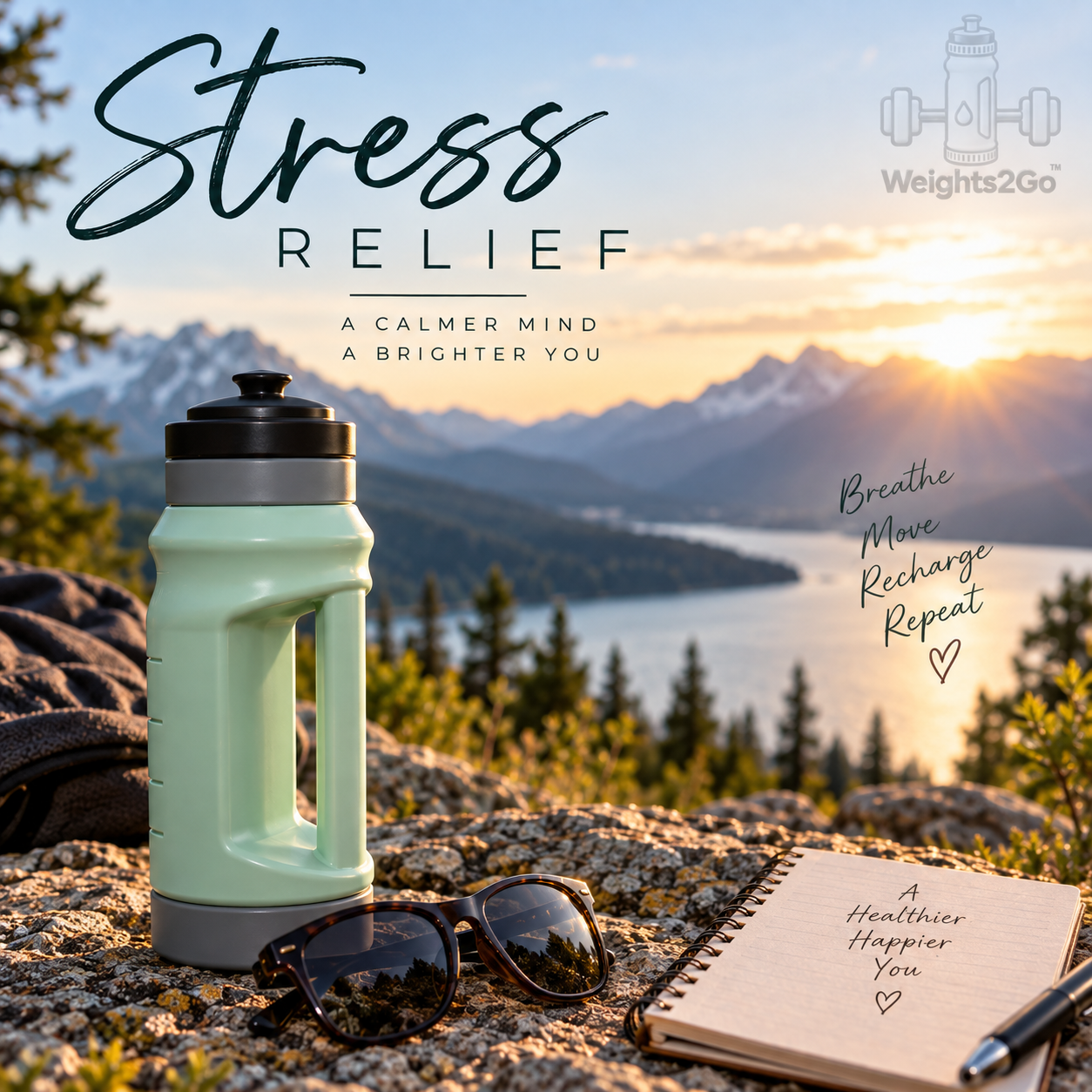
When we bring Weights2Go sports bottles to market, then you can head outdoors with a pair of Weights2Go Weighted Sports Bottles, and combine your hydration with resistance exercise too.
Move your body, clear your mind, and enjoy being outdoors.
🟢 Connect with Others
When we’re stressed, it can be tempting to withdraw from everyone and try to deal with everything ourselves, but spending time with people who we enjoy being with can be an important part of maintaining our wellbeing.
Research has consistently found associations between social connection and better mental and physical health. Social isolation and loneliness are associated with poor health outcomes.
So, pick up the phone, message a friend, or arrange that coffee. Go for that walk.
We don’t always have to deal with everything alone.
🟢 Take Control
When we’re overwhelmed, everything can sometimes feel completely out of our control. One useful strategy is to separate the things that you can control from the things that you can’t control.
You may not be able to control everything that’s happening around you, but there may be small things that you can control.
Perhaps you can make a phone call, organise a list, ask someone for help, deal with one problem at a time, or simply decide what you’re going to do next. Taking practical action can sometimes help us to feel less overwhelmed.
It doesn’t mean that the problem suddenly disappears. It simply means that you’re taking the next step, and sometimes, that’s enough to get started.
When we’re overwhelmed, everything can sometimes feel completely out of our control. One useful strategy is to separate the things that you can control from the things that you can’t control.
You may not be able to control everything that’s happening around you, but there may be small things that you can control.
Perhaps you can make a phone call, organise a list, ask someone for help, deal with one problem at a time, or simply decide what you’re going to do next. Taking practical action can sometimes help us to feel less overwhelmed.
It doesn’t mean that the problem suddenly disappears. It simply means that you’re taking the next step, and sometimes, that’s enough to get started.
🟢 Work Smarter
It may sound obvious, but when we’re stressed, our To-Do List can seem never-ending. Don’t try to complete everything at once, because this is a sure way of feeling even more overwhelmed.
I often have a to-do-list for a day, or for over three days. I check-off one thing when it’s done, and move on to the next. Obviously, we complete the most important task first of all.
So, prioritise. What actually needs to be done today? What can wait until tomorrow? What can someone else help with? Or, is there something that doesn’t need to be done at all?
You don’t have to accomplish everything in one day.
The World Health Organization recommends maintaining a daily routine and setting aside time for important activities, including exercise, recreation, family and other responsibilities. Having some structure to our day can help us to use our time more efficiently and to feel more in control.
Sometimes, putting something on tomorrow’s list isn’t failure, it’s simply being realistic.
🟢 Challenge Yourself
Learning something new can be a great way to step outside of our usual routine.
Take up a new hobby. Learn another language. Try cooking something you’ve never made before. Or perhaps challenge yourself physically by trying a new form of exercise.
Or, as simple as it sounds, take your run or walk a different route, and enjoy the scenery.
Learning and doing something new can provide us with a sense of achievement and give us something positive to focus on. When we develop a new skill, the sense of accomplishment may also help us to build more confidence.
It needn’t be something huge to matter. Sometimes, simply trying something different is enough.
🟢 Make Time for Some ‘Me-Time’
This is an important one. Whether your idea of me-time is exercise, reading, listening to music, meeting friends, gardening, watching a favourite movie, going for a walk, or simply sitting quietly with a cup of tea, try to make time for it; AND do not feel guilty!
Life isn’t just about work, responsibilities and getting things done. We also need time to relax and recharge.
Making time for enjoyable activities can be part of a healthy routine rather than something we only do when everything else has been completed.
So, if there’s something you would like to do, and have been putting it off, go ahead and book it up, put it in your calendar, and enjoy looking forward to that activity.
AND when the day arrives, try not to cancel it simply because your To-Do List has grown. Make a promise to yourself that you won’t cancel.
Sometimes, having something enjoyable to look forward to can be a welcome reminder that life isn’t all about responsibilities.
🟢 Try Practising Gratitude
When we’re stressed, it’s very easy for our attention to become focused on everything that’s going wrong.
One simple strategy that you can try is to think about, or write down, a few things that you’re grateful for. It might be something significant, but it could also be something incredibly simple.
A beautiful morning. A good night’s sleep. A lovely walk. A phone call from a friend. A delicious meal. Time with your family. A sunny day. Or simply, having a few quiet minutes to yourself.
Research into gratitude interventions suggests that deliberately practising gratitude may have benefits for mental wellbeing, although the evidence isn’t as simple as saying that gratitude automatically reduces stress for everyone.
A systematic review of gratitude interventions among workers found that several studies reported improvements in perceived stress and depression, while effects on overall wellbeing were less consistent.
So, rather than thinking that “being positive will solve everything,” perhaps think of gratitude as one small tool that can help us to notice some of the good things that can otherwise be overlooked when we’re under pressure.
🟢 Avoid Turning to Unhealthy Habits
When we’re stressed, it’s very easy to reach for something that gives us a quick feeling of relief.
Perhaps an extra coffee. A cigarette. A beer or glass of wine. Or another habit that temporarily takes our mind away from what’s bothering us.
The problem is that temporary relief doesn’t necessarily solve the underlying stress. In some circumstances, these substances can actually make things worse.
For example, a 2026 systematic review of studies involving healthy individuals found evidence of a dose-dependent relationship between caffeine and anxiety, although individual responses varied.
A 2024 meta-analysis also found that caffeine intake was associated with increased anxiety, particularly at higher doses.
That doesn’t mean that you need to give up your morning coffee! However, if you’re already feeling anxious or stressed, it may be worth paying attention to how much caffeine you’re consuming, and whether it seems to affect you personally.
Rather than automatically reaching for alcohol, or some other unhealthy coping mechanism, at the end of a stressful day, try something else first. Go outside. Take a few deep breaths. Have a stretch. Listen to some music. Call a friend. Or go for a walk.
I know that I keep mentioning walking, that’s probably because it helps me, and I enjoy it.
🟢 Don’t Forget to Breathe
When we’re stressed, we can become so caught up in what we’re doing that we forget to stop for a moment.
So, pause. Take a breath. Relax your shoulders. Walk around the office. Step outside for some fresh air.
Even a few minutes away from your desk can provide a useful mental break.
The WHO’s guide, Doing What Matters in Times of Stress, includes practical techniques that can be practised for just a few minutes at a time, including grounding, noticing thoughts and feelings, and responding to ourselves with greater kindness.
In spirituality, grounding is the practice of anchoring your energy to the physical world and the present moment.
You don’t necessarily need an hour of meditation, or a completely stress-free environment.
Sometimes, a few minutes can be a good place to start.
If you have time…get outside!
This is really what stress management is about.
It isn’t about creating a life where we never experience stress. That’s probably impossible.
It’s about learning how to recognise stress, finding healthy ways to cope with it, and making time for the things that help us to recover.
So, next time life feels like a juggling act, remember:
You don’t have to put every ball down. Perhaps just put one of them down for a while.
Take a breath. Go for a walk. Call a friend. Do something you enjoy.
More importantly, give yourself permission to take care of you.
If there is some repetition in this article, my apologies, but I know from experience that sometimes repetition helps us to learn. I have to keep reminding myself of these strategies on certain days, too.
Disclaimer
This article is for general educational and informational purposes only and is not intended to diagnose, treat or replace professional medical or mental-health advice. If stress is persistent, overwhelming, interfering with your daily life, or affecting your sleep, relationships or ability to function, consider speaking with a qualified healthcare professional.
Research & Further Reading
- World Health Organization (2026). Stress – Questions and Answers. A current WHO resource covering what stress is, how it can affect us, and practical approaches including exercise, sleep, routines and connecting with others.
- World Health Organization (2020). Doing What Matters in Times of Stress: An Illustrated Guide. An evidence-informed guide containing practical stress-management techniques that can be practised in just a few minutes.
- Singh, B. et al. (2023). Effectiveness of physical activity interventions for improving depression, anxiety and distress: an overview of systematic reviews. British Journal of Sports Medicine, 57, 1203–1209. This large umbrella review included 97 systematic reviews, 1,039 trials and 128,119 participants and found beneficial effects of physical activity on depression, anxiety and psychological distress.
- Heissel, A. et al. (2023). Exercise as medicine for depressive symptoms? A systematic review and meta-analysis with meta-regression. British Journal of Sports Medicine, 57, 1049–1057. This review of randomised controlled trials found substantial benefits of exercise for depressive symptoms, while also noting limitations and variation between studies.
- Cohen, S. et al. / social-connection literature. Research examining social connection and health consistently finds associations between stronger social relationships and better health outcomes, while loneliness and social isolation are associated with poorer mental and physical health.
- Kobayashi, T. et al. (2021). Effects of gratitude intervention on mental health and well-being among workers: A systematic review. The review found evidence that gratitude interventions may improve perceived stress and some aspects of mental health, although effects on overall wellbeing were less consistent.
- Nascimento, A. O. et al. (2026). The Effects of Caffeine on Anxiety Behavior in Healthy Individuals: A Systematic Review of the Literature. Stress and Health. The review found evidence suggesting that caffeine can increase anxiety in a dose-dependent manner, although individual responses differ.