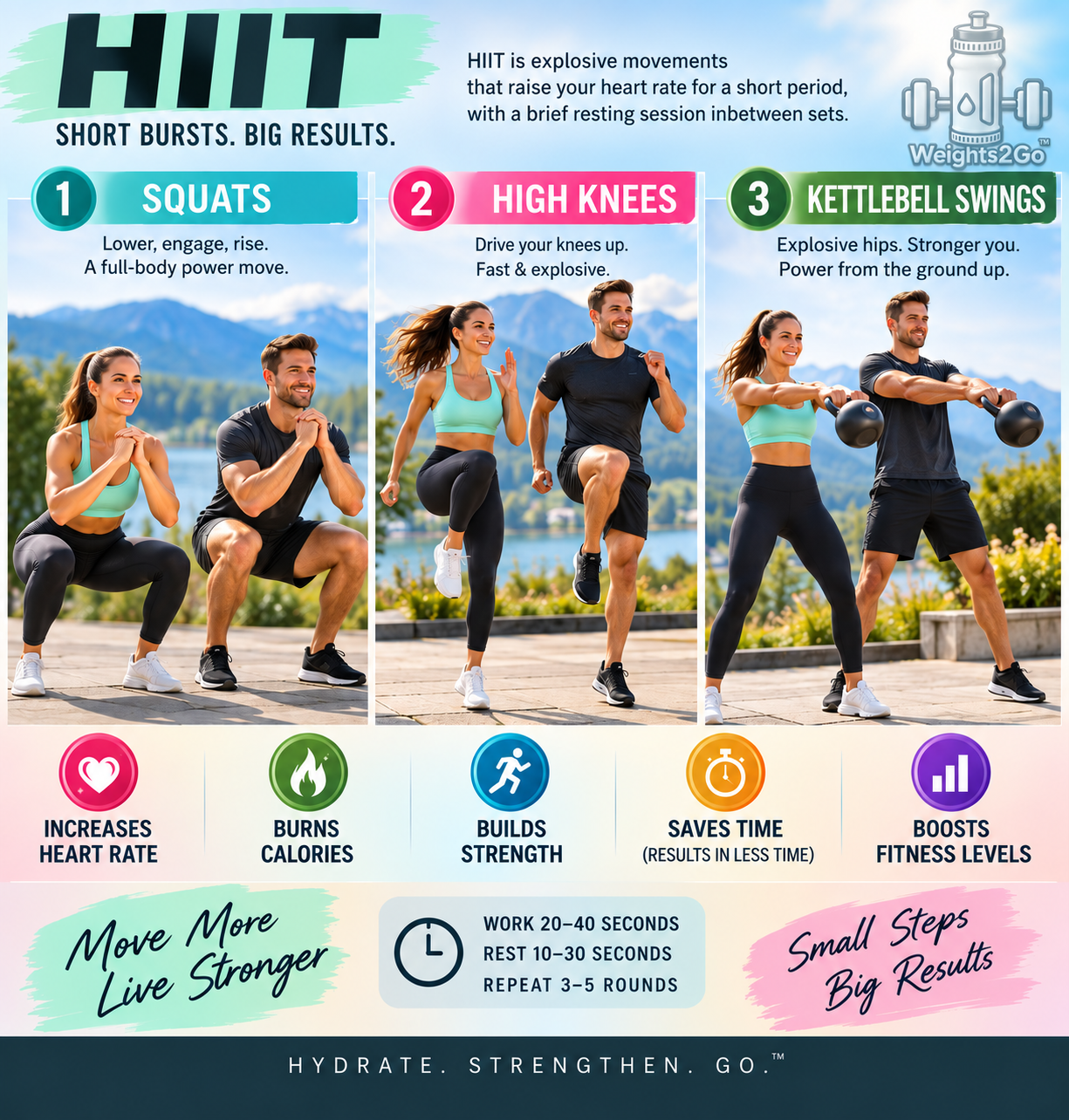
HIIT stands for High-Intensity Interval Training, and it can include cardio, strength-training exercises, or a combination of both, depending on the workout you choose.
So, what exactly is HIIT?
HIIT involves alternating short periods of relatively high-intensity exercise with periods of lower-intensity exercise or rest.
The high-intensity periods are designed to make you work hard, increasing your heart rate and breathing rate, before allowing your body a short recovery period. You then repeat the pattern for a number of intervals.
The great thing about HIIT is that it can be very time-efficient. Research has found that even relatively short HIIT sessions can improve cardiorespiratory fitness and several measures of cardiometabolic health, including blood pressure. In some studies, HIIT has produced similar improvements to longer periods of moderate-intensity exercise.
That doesn’t mean HIIT is necessarily “better” than other forms of exercise; but rather, it can be a very useful option if you’re short on time, or simply enjoy exercising this way.
Can HIIT help with weight loss?
HIIT can certainly be part of a healthy weight-loss programme. It can increase energy expenditure during exercise, and, because you are exercising at a high intensity, your body can continue to use more oxygen, and energy, even during recovery. This is sometimes referred to as the “after-burn effect,” or scientifically, Excess Post-Exercise Oxygen Consumption (EPOC).
Research suggests that EPOC can be greater following high-intensity exercise than moderate-intensity continuous exercise. However, it’s important not to overestimate this effect; the extra calories burnt after exercise are helpful, but they aren’t a magic solution for weight loss.
Research comparing HIIT with moderate-intensity continuous exercise has found that both can improve body composition, while HIIT can achieve similar results with less exercise time in some circumstances.
What about strength-training?
HIIT doesn’t have to be all about running, cycling or jumping. You can include exercises such as Squats, Lunges, Press-ups and other resistance exercises, creating a whole-body workout that challenges your muscles as well as your cardiovascular system.
If you use Dumbbells, Kettlebells, or Weights2Go Weighted Sports Bottles, resistance can be added to suitable exercises, to increase the challenge.
Whole-body HIIT has been shown to improve cardiorespiratory fitness, fat mass, and, musculoskeletal fitness, compared with not exercising.
However, if your main goal is to build as much muscle and strength as possible, traditional resistance-training programmes may still be more appropriate than trying to turn every strength workout into HIIT.
So, what exercises can you do?
The exercises you choose will depend on your fitness level, preferences, available space and the equipment you have.
You could use:
- Your own body weight
- Dumbbells
- Kettlebells
- Resistance bands
- A stationary bike
- A skipping rope
- Or, Weights2Go Weighted Sports Bottles
For example, you could create a simple HIIT circuit using five exercises:
1. Squats
2. Burpees
3. Press-ups
4. Lunges
5. Jumping Jacks
You could exercise for 30–45 seconds, followed by 15–30 seconds of recovery, before moving onto the next exercise.
Repeat the circuit several times, depending on your fitness level, and how much time you have.
It’s important to know that, you don’t have to exercise at maximum effort, every single time. High intensity should be relative to your own fitness level. If you’re new to HIIT, start gradually and allow yourself enough recovery between intervals.
If you’re using Weights2Go Weighted Sports Bottles outdoors, you can use the weights to add resistance to suitable exercises, while also having your water with you, to stay hydrated.
Prefer cycling? Try this!
A stationary bike can be a great way to introduce HIIT, particularly if you prefer a lower-impact form of exercise. For example, you could cycle hard for around 20–30 seconds, followed by a longer period of easy cycling to recover.
You could start with 4–6 intervals, gradually increasing the number or duration of your hard efforts as your fitness improves.
Cycling is also a useful option if you want to reduce the impact on your joints compared with activities such as running and jumping.
Also, a favourite playlist makes it even more enjoyable!
What about HIIT and your heart?
HIIT can be an effective way of improving cardiorespiratory fitness, in other words, how efficiently your heart, lungs and circulatory system work during exercise.
Research has consistently shown improvements in cardiorespiratory fitness following HIIT, and newer research suggests that even low-volume HIIT can improve fitness while also helping to reduce blood pressure.
However, because HIIT is demanding, it isn’t necessarily suitable for everyone straight away.
The bottom line
HIIT can be a fantastic addition to your exercise routine.
It’s time-efficient, versatile and challenging, and it can help to improve cardiovascular fitness, support healthy body composition, and, contribute to your overall health and fitness.
You don’t need an expensive gym membership or lots of equipment either. You can create an effective HIIT workout at home, in the garden, at the park, or almost anywhere you have enough space to exercise safely.
Additionally, by combining cardiovascular exercise with resistance-training throughout your overall exercise programme, you can work on different aspects of fitness, ie, cardiovascular fitness, muscular strength and body composition.
The most important thing is, finding activities that you enjoy, can perform safely, and can stick with.
So, why not give HIIT a try?
Start at your own fitness level, take those recovery periods when you need them, and gradually build from there!
Disclaimer: The information provided here in this article, and website, is for general educational purposes only, and is not intended to replace professional medical or healthcare advice. Before making changes to your diet, exercise or fitness routine, please consult a qualified healthcare professional, to ensure that it’s healthy and appropriate for you.
Research & Further Reading
Yin et al. (2024) — Is low-volume high-intensity interval training a time-efficient strategy to improve cardiometabolic health and body composition? A meta-analysis.
Very useful for your claims about time efficiency, cardiorespiratory fitness, blood pressure and body composition.
García-Hermoso et al. (2022) — Effectiveness of Whole-Body High-Intensity Interval Training on Health-Related Fitness: A Systematic Review and Meta-Analysis.
Particularly useful for whole-body HIIT, fitness, fat mass, fat-free mass and musculoskeletal fitness.
Higgins et al. / systematic review and meta-analysis (2023) — HIIT versus moderate-intensity continuous training for fat loss and cardiorespiratory fitness. This is useful for supporting the point that HIIT can produce similar or, for some measures, somewhat better results than MICT while being more time-efficient.