Do you like to exercise outdoors?
There’s something quite wonderful about exercising outside. Whether you enjoy walking, jogging, running, hiking, cycling, or simply getting out into the fresh air, exercising outside can make your workout feel less like a chore, and more like something to look forward to.
For me, exercising outdoors, especially when the weather is warm and sunny is positively amazing. I find that exercising in gorgeous weather is quite motivating. However, personally, I find that exercising outside in winter, especially when it’s snowy, can be a bit of a task, and it takes both motivation and willpower to get me out there. It requires wearing layers, which can be a bit of a hassle. However, once I’m out, and surrounded by nature, it’s still very enjoyable. This is a reminder that, we don’t need perfect weather to exercise outside. Sometimes, getting outdoors and moving, is exactly what we need!
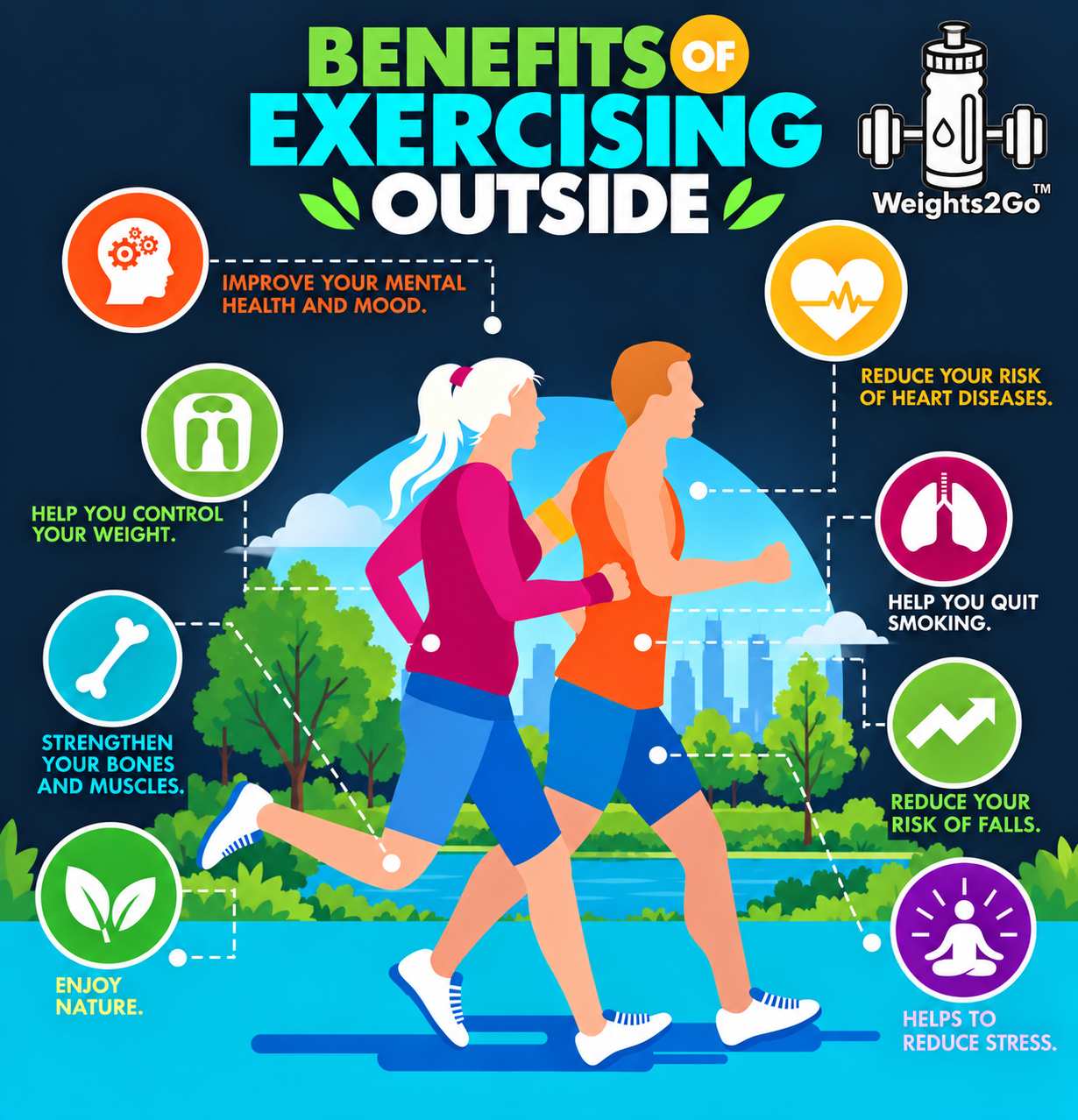
So, what are the benefits of exercising outside?
As we know, exercise of any kind is good for both our body, and, our mind.
Whether you enjoy Cardio, Strength-training, walking, running, cycling, hiking, or another form of exercise, regular physical activity can contribute to better cardiovascular health, physical fitness, muscular strength, and, improved mental health.
Research has consistently associated regular physical activity with a lower risk of cardiovascular disease and premature death. Also, when we exercise outdoors, there may be some additional benefits.
Exercise, and, Nature
Have you ever noticed that you can feel quite different after exercising outdoors, compared with exercising indoors?
Perhaps it is the fresh air, the sunshine, the scenery, or simply the fact that you are away from your usual surroundings.
There is growing research into what is often referred to as ‘Green Exercise’ – physical activity performed in, or around, natural environments.
A 2026 systematic review and meta-analysis of 51 studies found that green exercise was associated with improvements in several measures of mental wellbeing. Other research has also found that physical activity undertaken in natural outdoor environments can have positive effects on psychological outcomes such as anxiety, fatigue, positive mood, and vigour.
However, I think it is important to keep this in perspective; the research does not mean that exercising outdoors is automatically better than exercising indoors.
So, perhaps the biggest benefit of outdoor exercise is quite simple:
If you enjoy it more, you may be more likely to keep doing it! As I’ve mentioned before, consistency is important when it comes to exercise.
One of the great things about exercising outdoors is the variety. You don’t necessarily need a gym, expensive equipment, or a complicated workout plan.
You can go for a walk. You can increase the pace and turn it into a brisk walk. You can jog or run. If you use our Weights2Go Weighted Sports Bottles, you’ll gain the extra bit of resistance, all while being able to hydrate!
I particularly enjoy hiking in the Mountains, where the scenery can be amazing. However, mountain terrain can also be unpredictable. Loose and/or uneven surfaces can make exercising considerably more dangerous, and demanding, and without care (and the proper footwear) injuries can happen. This is why, preparation is so important, and, we will look at this in another article, in our Weights2Go Community.
What about the Cellular Benefits of Exercise?
This is particularly interesting. Have you may have heard of Autophagy? In basic terms, autophagy is a natural cellular recycling process. It helps cells to break down and recycle damaged or unwanted components.
Exercise appears to influence autophagy, and, researchers are particularly interested in whether this process may contribute to some of the health benefits associated with exercise.
Much of the early research into exercise and autophagy came from animal studies. Human research is more complicated, and, the response appears to depend on the type of exercise, its intensity, and, the duration of the exercise.
One study review has highlighted that measuring autophagy accurately in living humans is difficult, which is one reason why some of the claims made about exercise and autophagy can be much stronger than the evidence currently allows.
So, while autophagy is certainly an interesting area of research, I would not say that exercise simply ‘switches on cell repair.’ Science is still learning!
Moving your body regularly matters, especially so as we get older. Outdoor Exercise Can Be Fun! and often, the best exercise programme is the one that you enjoy enough, to keep doing.
So, why not get outside, enjoy the fresh air, and, make the most of your surroundings?
Just remember that outdoor exercise does require a little preparation, particularly if you are running, hiking, cycling, or exercising in extreme temperatures.
Read my article, here in our Weights2Go Community page, about how to prepare for outside exercise, including footwear, clothing, hydration, warm-ups, routes, air pollution, technology, and, some simple ways to help reduce your risk of injury.
Research & More Reading
Does Exercise Regulate Autophagy in Humans? A Systematic Review and Meta-Analysis
Chen et al.
This systematic review and meta-analysis examined 26 human studies and found that the effects of exercise on autophagy vary according to exercise type and tissue.
Autophagy and Exercise: Current Insights and Future Research Directions
Botella, Shaw & Bishop
A useful review explaining what we currently know, and, importantly, what we still don’t know about exercise and autophagy in humans.
Effects of Green Exercise on Mental Health: A Systematic Review and Meta-Analysis
Liu et al., 2026
A recent systematic review and meta-analysis examining the mental-health effects of exercising in green environments.
Disclaimer
The information provided here in this article, and on this website, is for general educational and informational purposes only. It is not intended to replace medical advice, diagnosis, or treatment, from a qualified healthcare professional.
If you are new or returning to exercise, have an existing medical condition, or are taking medication, have concerns about your health, or are unsure whether a particular form of exercise is suitable for you, speak with your doctor or another appropriately qualified healthcare professional, before starting or changing your exercise programme, and, nutrition.
Research is continually evolving, and, individual responses to exercise can vary considerably.