Walking is a great form of exercise that’s highly underrated by many.
I started walking, a lot, after an orthopedic surgeon advised me to stop running, even on a treadmill. I can’t say I loved walking at first, but I really began to enjoy it. Over time, I’ve grown to love ‘walking,’ especially when I’m out in nature, exploring trails and hiking in the mountains.
Plus, walking is absolutely free – zero gym membership required!
This is where Weights2Go comes in. Walking with Weights2Go Weighted Sports Bottles means that you can hydrate, which is extremely important, while also adding a little resistance to your exercise routine.
Using our bottles with the weights attached while walking, hiking, jogging or taking part in other suitable fitness activities can provide an additional challenge and incorporate more upper-body movement into your exercise. Plus, you can hydrate easily, all at the same time!
Walking is often discussed on social media, with new walking plans and trends appearing all of the time – from the 6-6-6 method to claims about specific walking techniques for lymphatic drainage.
The 6-6-6 method generally suggests walking for 60 minutes at either 6am or 6pm, six days a week.
Could this work for you? Perhaps; but it won’t necessarily fit in to everyone’s lifestyle, and, it doesn’t have to.
If you can walk for 60 minutes, that’s great. If you can walk for 30 minutes, that’s great too; and, if your schedule only allows you to fit in several shorter walks throughout the day, those can still contribute to your overall physical activity.
The important thing is finding a level of activity that works for you, and, gradually building from there.
What about lymphatic drainage?
You may also have seen posts suggesting that walking in a particular way, combined with a particular breathing technique, can improve lymphatic drainage.
The Lymphatic System is a network of vessels and nodes, that clear and drain, waste, bacteria, and excess fluid, from your body’s tissues; this being known as lymphatic drainage.
There is some science behind the idea that physical activity can influence lymph flow.
Muscle contractions help to move lymph through the lymphatic system, which doesn’t have a central pump like the cardiovascular system does. However, we should be cautious about claims that one particular walking technique, or breathing pattern, is a proven way to ‘drain’ the lymphatic system.
We’ll discuss the lymphatic system and lymphatic drainage in more detail here in the Weights2Go Community section, so keep an eye out for that article.
We’ve spoken about why hydration is so important, and, why resistance training is also very important, especially as we age.
For a quick reminder, please see our other articles, right here on the Weights2Go Community page.
So, what are some of the health benefits of walking?
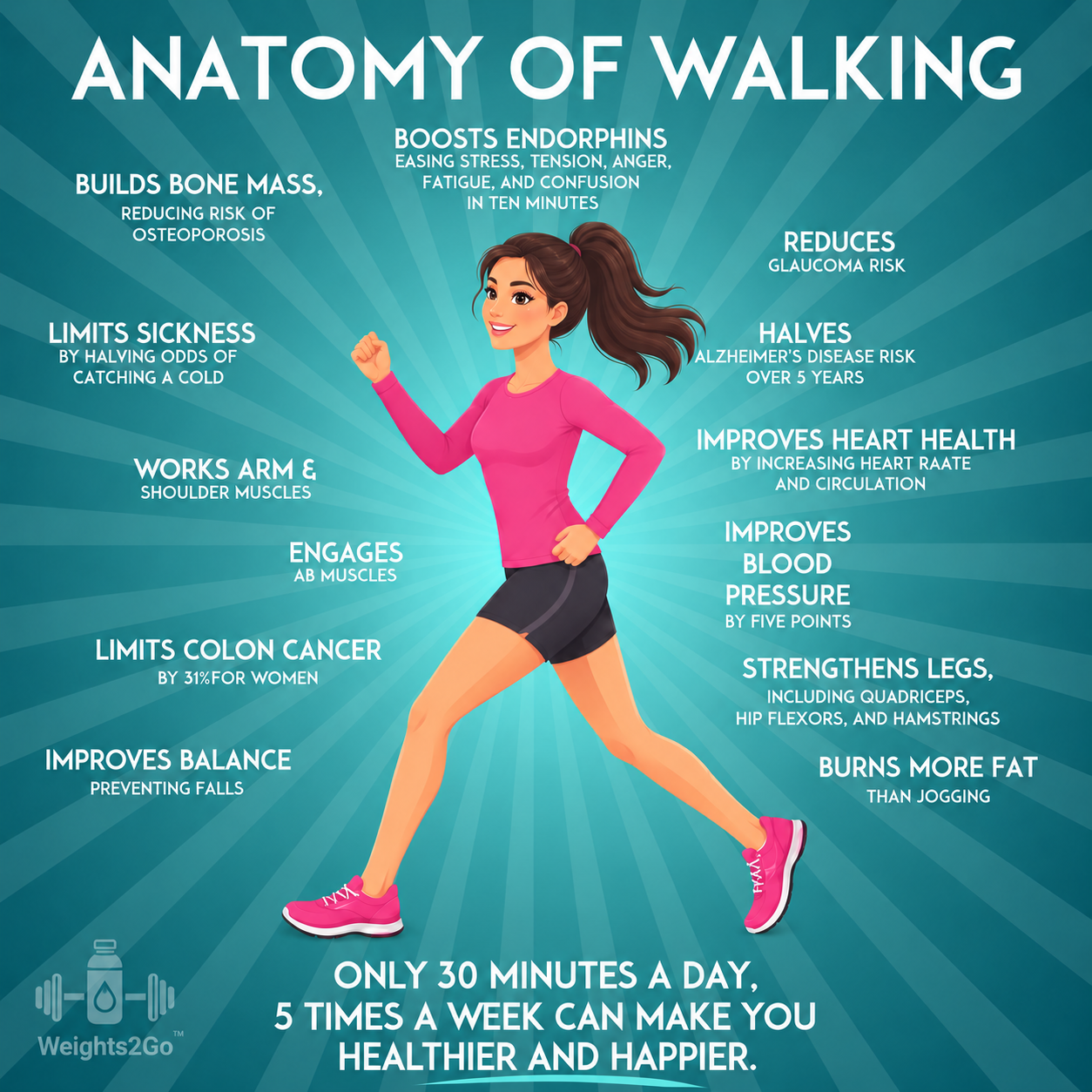
Walking can contribute to overall physical activity and is associated with a number of health benefits, including:
- Strengthening the legs and supporting cardiovascular health ❤️
- Helping to maintain healthy bones 🦴
- Supporting mood and mental wellbeing 😊
- Improving fitness and helping with weight management ⚖️
- Helping to reduce the risk of conditions such as Type 2 diabetes, cardiovascular disease and high blood pressure 🛡️
And there may be even more benefits.
Harvard Medical School research reveals some interesting findings
Harvard Health has highlighted research suggesting that walking may:
- Help counteract the effects of certain weight-promoting genes 🧬
- Help reduce cravings for sweet foods 🍬🚫
- Ease some forms of joint pain 🦵
- Reduce the risk of certain cancers 🎗️
- Support immune function 🌿
- Improve balance and physical function 🧘♀️
So, what does “counteracts weight-promoting genes” actually mean in plain English?
Well, a little explanation might help.
Research involving more than 12,000 people examined 32 obesity-associated genetic variants and found that the relationship between these genetic factors and body weight was weaker among people who regularly engaged in brisk walking.
In other words, your genes can contribute to a tendency towards weight gain, but lifestyle factors can influence how strongly that tendency is expressed.
It’s rather like having a genetic tendency pushing in one direction, while regular physical activity pushes back in the other direction.
It’s important to know that, exercise doesn’t switch your genes off, or reverse them. It’s much more complicated than that.
The research simply suggests that regular physical activity may help, to reduce the influence of certain genetic factors, on obesity risk.
Do I really need 10,000 steps a day?
You may have heard that you need 10,000 steps a day to be healthy.
The good news is that you don’t necessarily need to reach 10,000 steps every day to benefit from being active.
One large study involving 16,741 older women, with an average age of 72, found that women averaging approximately 4,400 steps per day had a significantly lower mortality rate than those averaging around 2,700 steps per day. The association continued to improve as step numbers increased, before levelling off at around 7,500 steps per day.
Importantly, this doesn’t mean that 4,400 steps are a magic number, or that everyone should aim for exactly 4,400 steps. The study was observational, and it looked specifically at older women.
The message is, much-more simple:
You don’t have to reach 10,000 steps before your movement ‘counts.’
Some activity is better than none, and gradually increasing your activity according to your abilities and circumstances is a sensible approach.
What about 150 minutes of exercise a week?
You may also have heard that adults should aim for 150 minutes of physical activity each week.
Current Canadian physical-activity guidance recommends that adults accumulate at least 150 minutes of moderate-to-vigorous physical activity each week, alongside muscle- and bone-strengthening activities. For older adults, activities that challenge balance are also recommended.
So yes, 150 minutes is a great target, but don’t be discouraged if you’re nowhere near it, yet.
Start with what you can manage, and gradually work your way up.
Also, remember that, everyday movement matters too. Walking the dog, gardening, taking the stairs, walking to the shops or going for a hike, can all help you to become more active.
If you’re concerned about your health, new to exercise, or you’re restarting your fitness journey after a break, it’s sensible to speak with a qualified healthcare, or exercise professional, before starting a new exercise programme.
Consistency matters
By adding walking to your daily or weekly routine, you may find that you begin to feel better, both physically and mentally.
Remember: movement and consistency are what matter. Ifthe enjoyment isn’t there initially, believe me, it can follow. I know this from experience.
I really miss the ‘high’ that you feel after a great run, but I can also get that feeling from a mountain hike too!
Also, remember: good shoes are key! 👟
Comfortable, supportive footwear can help to protect your feet, and, reduce the chance of developing problems that can keep you away from the activities you enjoy. Good shoes also help sore knees. My running shoes were getting a little thin on the soles, so I had to buy another pair; I buy ‘runners’ because I get through a lot of ‘mileage’ throughout each week.
Exercise doesn’t have to be painful, exhausting or performed in a gym to count.
Walking is exercise, and, it can be enjoyable.
So, grab a friend, take the dog, listen to some music along the route, or simply, enjoy the peace and quiet.
A pair of Weights2Go Weighted Sports Bottles will carry your water while providing some resistance training – it’s a Win-Win.
Get outside, get moving, and, WALK to Wellness! 💖
Research & Further Reading
Research and information for this article have been drawn from sources including PubMed, Harvard Medical School/Harvard Health, JAMA and Canadian government physical-activity guidance.
Disclaimer
The information provided here in this article, and website, is for general educational purposes only, and is not intended to replace professional medical or healthcare advice. Before making changes to your diet, exercise or fitness routine, please consult a qualified healthcare professional, to ensure that it’s healthy and appropriate for you.