Have you heard of Intermittent Fasting (IF) or Time-Restricted-Eating (TRE)?
Perhaps you already fast regularly, or maybe you’re wondering what all the fuss is about.
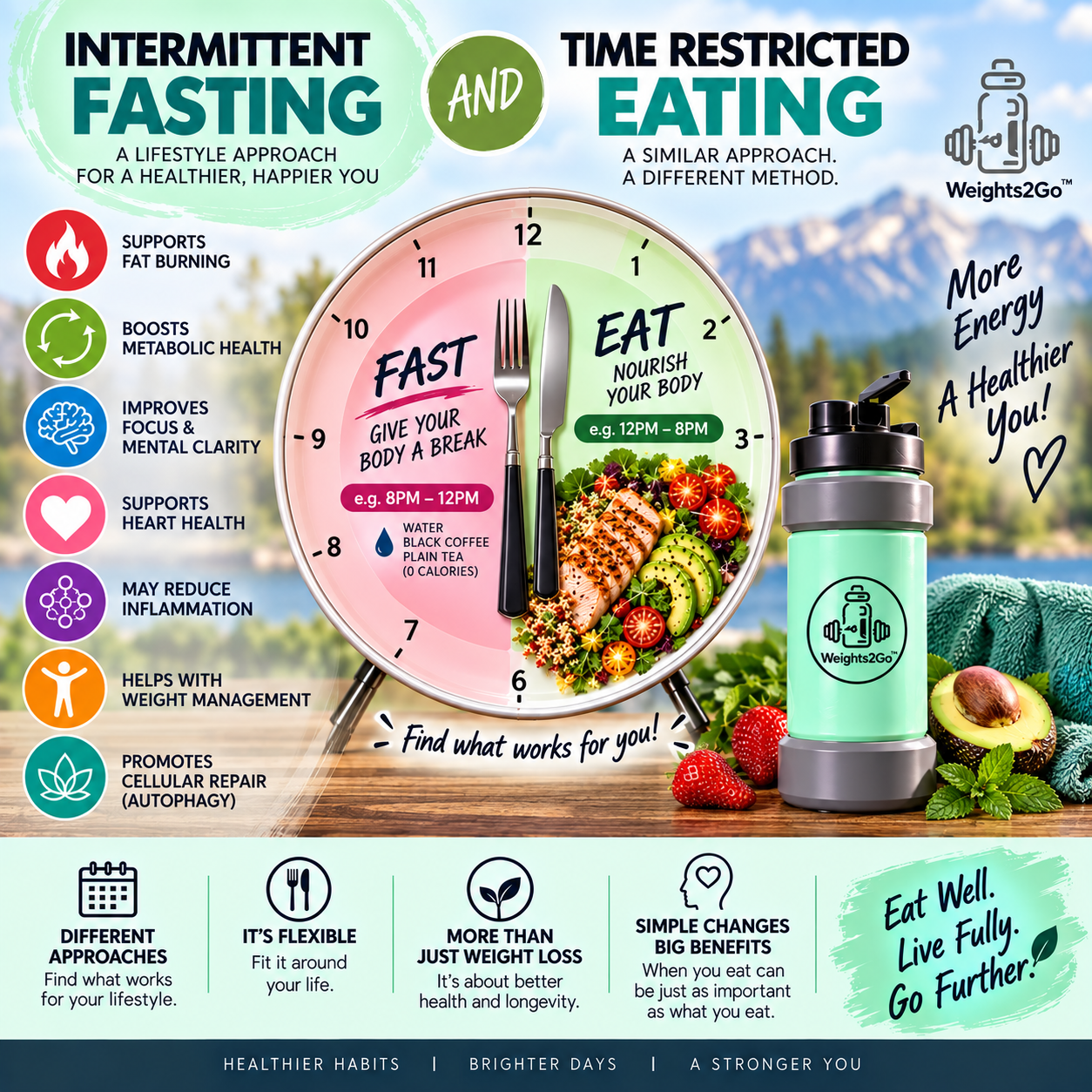
Although the terms are often used interchangeably, IF and TRE are related, but they’re not the same thing.
So, what’s the difference?
Intermittent Fasting (IF) is an eating pattern where you alternate between periods of eating and fasting (fasting is not eating, and, is only drinking water, for a certain period of time).There are several different approaches, including alternate-day fasting, the 5:2 approach and daily fasting.
I have fasted, or as I call it, done ‘IF’ – Intermittent Fasting, daily for several years now.
Time-Restricted Eating (TRE) is a form of IF where you eat within a consistent daily time ‘window’.
For example, 16:8 means fasting for approximately 16 hours and eating within an 8-hour window each day; BuT remember, this doesn’t mean eating several bowls of ice-cream during the eating window – wouldn’t that be nice?! Seriously though, it’s all about sensible healthy eating, during your window.
So, in simple terms:
IF = periods of eating and fasting.
TRE = eating within a specific daily time window.
They’re closely related, but TRE is more specifically focused on when you eat.
Does fasting help with weight loss?
Research suggests that fasting can be an effective way of losing weight, particularly for people who find that, having a defined eating pattern, helps them reduce their overall food intake.
Personally, believe it or not, I only heard about fasting and IF, along with a Low Carb way of eating, when I moved to Spain.
As I mentioned with the ice-cream comment, it’s important to know that, fasting isn’t a magic weight-loss switch.
Recent research involving thousands of participants suggests that intermittent fasting can reduce body weight and improve some metabolic markers, but its benefits are generally similar to those achieved through conventional calorie restriction.
In other words, what you eat, how much you eat, and whether you can maintain the eating pattern long-term, still matter. Again, it’s important to know that, you can’t necessarily compensate for an entire day of fasting by eating large amounts of highly processed foods, during your eating window!
What about TRE?
TRE is particularly interesting because it focuses on meal timing.
Research has found that TRE (Time Restricted Eating) can produce modest reductions in body weight and fat mass, although results vary between studies and individuals.
Interestingly, a 12-month randomised trial found that when people were already following a calorie-restricted diet, adding an 8-hour eating window did not produce significantly greater weight loss than calorie restriction alone. However, this doesn’t mean that TRE doesn’t work.
It means that TRE may be a useful eating structure for some people, rather than a magical method that automatically causes weight loss; and, that distinction is important.
What happens when we fast?
When you stop eating, your body gradually changes how it obtains and uses energy.
Insulin levels generally fall and, as fasting continues, the body increasingly uses stored energy, including fat, as a fuel source. Longer periods without food can also increase ketone production. Fasting also appears to affect a number of cellular and metabolic pathways.
You may have heard of autophagy, sometimes described as the body’s cellular ‘recycling’ system.
Autophagy is a genuine biological process in which cells break down and recycle damaged or unwanted components. However, I think it’s important not to overstate what we currently know.
Fasting can influence pathways involved in autophagy, but we cannot simply say that fasting for a particular number of hours switches autophagy ‘on’ and provides guaranteed health benefits in humans. The science is much more complicated than that.
Can fasting improve health?
There is promising evidence that intermittent fasting, IF, can help improve some measures of metabolic health, particularly in people who are overweight, or who have, metabolic risk factors.
Research has reported improvements in areas such as:
- body weight and waist circumference
- body fat
- fasting insulin
- some blood lipid measures
- certain markers of metabolic health
However, the size of these benefits varies considerably between studies, and, individuals.
There is also considerable interest in whether fasting might influence inflammation, brain health, ageing and longevity. These are fascinating areas of research, but we shouldn’t turn promising scientific findings into guarantees. For example, evidence for increased lifespan is much stronger in animal research than in humans.
My own experience
I’ve followed intermittent fasting for several years, and personally, I find it works well for me.
I usually find that fasting for around 14 to 20 hours suit’s me better than longer fasts. I have tried a longer fast, and I reached almost 30 hours, only drinking water. This was with a fasting group, online. I decided that longer fasting simply wasn’t for me.
This is the point, there isn’t one fasting method that works for everyone. What works for one person may be completely unsuitable for another.
I also believe that fasting should become something that fits into your lifestyle, rather than, something that makes your life miserable!
If you’re thinking about trying IF please know that you don’t have to jump straight into a long fast. In my opinion, that would not be good for you, nor would it be enjoyable. When I tried the longer fast, I had already been fasting for a year or so.
Some simple things to consider are:
- Start gradually. Give your body time to adjust.
- Focus on nutritious food during your eating window.
- Include plenty of protein, fibre and nutrient-dense foods.
- Stay hydrated.
- Don’t use fasting as an excuse to overeat during your eating window.
- Keep exercising, including resistance training, if appropriate for you.
- Pay attention to how you feel.
- And remember your ‘Why’
I particularly like the phrase: Delay, don’t, deny.
If you’re slightly hungry and your planned eating time is approaching, you may be able to wait, just try telling yourself, “If I’m still hungry in 30 minutes, then I will eat.’ Keep busy, and most of the time, you will forget about the hunger pang. However, if you feel unwell, dizzy, weak or otherwise not right, listen to your body.
Fasting should not be about ignoring warning signs.
Is fasting right for everyone?
No; and this is really important.
Fasting isn’t appropriate for everyone, and, some people should only consider it with professional medical guidance. If you’re new to Fasting, talk to your healthcare professional before trying to fast.
If you are pregnant or breastfeeding, have a history of an eating disorder, have diabetes or take medication that can be affected by changes in food intake, speak to your healthcare professional before trying intermittent fasting.
If fasting makes you feel unwell, it may simply not be the right approach for you.
The bottom line
Intermittent Fasting and Time-Restricted Eating are closely related approaches to eating, but they aren’t identical.
IF focuses on periods of eating and fasting, while TRE focuses particularly on restricting eating to a consistent daily time window. If you’re like me, you might prefer IF to TRE, as it gives you more choice over the hours, that you choose each day, rather than sticking to a rigid time-frame.
Research suggests that both approaches can be useful for some people, particularly for weight management and certain aspects of metabolic health.
As mentioned before, fasting isn’t a miracle diet.
There is no substitute for nutritious food, sensible portions, regular physical activity, adequate sleep and a lifestyle that you can actually maintain.
For me, fasting is simply one tool that fits into my lifestyle, but I’ll write about that fully another time, in a separate article, here on our Weights2Go Community page.
If you do decide to try fasting, remember, do what works for you.
Disclaimer: The information provided here in this article, and website, is for general educational purposes only, and is not intended to replace professional medical or healthcare advice. Before making changes to your diet, exercise or fitness routine, please consult a qualified healthcare professional, to ensure that it’s healthy and appropriate for you.
Research & More Reading
The following studies and reviews are good starting points if you’d like to explore the science behind intermittent fasting and time-restricted eating in more detail:
- Semnani-Azad Z, et al. (2025). Intermittent fasting strategies and their effects on body weight and other cardiometabolic risk factors: systematic review and network meta-analysis of randomised clinical trials. The BMJ.
A very large review of 99 randomised trials involving 6,582 adults, examining different fasting strategies and their effects on weight and cardiometabolic health.
Read the study on PubMed - Liu D, et al. (2022). Calorie Restriction with or without Time-Restricted Eating in Weight Loss. New England Journal of Medicine.
A 12-month randomised trial comparing calorie restriction alone with calorie restriction plus an 8-hour eating window.
Read the study on PubMed - de Cabo R & Mattson MP. (2019). Effects of Intermittent Fasting on Health, Aging, and Disease. New England Journal of Medicine.
A widely cited review explaining the biological mechanisms behind intermittent fasting and the evidence surrounding metabolism, health and ageing.
Read the review in the New England Journal of Medicine - Moon S, et al. (2024). Intermittent fasting and health outcomes: an umbrella review of systematic reviews and meta-analyses of randomised controlled trials. eClinicalMedicine.
This umbrella review examined 23 systematic reviews/meta-analyses and is useful for getting a broader picture of what the human evidence actually shows.
Read the review on PubMed - Wang X, et al. (2022). Metabolic Efficacy of Time-Restricted Eating in Adults: A Systematic Review and Meta-Analysis of Randomized Controlled Trials.
This review included 17 randomised trials involving 899 participants and found reductions in body weight and fat mass with TRE.
Read the study on PubMed - He M, et al. (2024). Does early time-restricted eating reduce body weight and preserve fat-free mass in adults?
A systematic review and meta-analysis examining early TRE, weight loss and body composition.
Read the study on PubMed